Project Management for AI Product Development
Today the most effective digital-development workflows leverage the speed and technical strengths of Artificial Intelligence alongside the judgment, creativity, and business insight of Human Intelligence (HI). While AI can generate code and accelerate execution, HI remains essential for defining the right system, translating business needs into actionable requirements, evaluating technical tradeoffs, and ensuring each feature functions as intended. digiM Consulting delivers this human-led direction by integrating product strategy, AI-assisted execution, user experience planning, quality assurance, and cost-effective decision-making to advance promising ideas from concept to production-ready digital systems.
Today the most effective digital-development workflows leverage the speed and technical strengths of Artificial Intelligence alongside the judgment, creativity, and business insight of Human Intelligence (HI).
While AI can generate code and accelerate execution, HI remains essential for defining the right system, translating business needs into actionable requirements, evaluating technical tradeoffs, and ensuring each feature functions as intended.
digiM Consulting delivers this human-led direction by integrating product strategy, AI-assisted execution, user experience planning, quality assurance, and cost-effective decision-making to advance promising ideas from concept to production-ready digital systems.
Turning Complex Digital Ideas Into Structured, Production-Ready Systems
Defining the Right Product Before Development Begins


AI can generate code quickly, but it cannot determine which product should be built, the best user experience, or what cannot be compromised.
That work begins with Human Intelligence (HI): clarifying the objective, understanding the audience, defining the experience, and translating an ambitious idea into a structured set of requirements that AI can act on.
Product development starts by defining what success actually looks like before execution begins. This early planning establishes the foundation for development by defining:
- Business and user objectives — what the system needs to accomplish and how people should experience it.
- Functional requirements and guardrails — how features should behave, what existing systems must be preserved, and what the development process should not change.
- Data, content, and workflow rules — how information is created, structured, reviewed, searched, stored, and presented.
- Operational realities — including platform limitations, privacy, recurring costs, scalability, and the resources required to maintain the product after launch.
By resolving these questions early, AI-assisted development becomes far more focused. Instead of asking AI to simply “build something,” digiM creates a clear framework in which AI can contribute effectively—while human judgment continues to guide the product’s purpose, priorities, and direction.
Orchestrating AI, Platforms, and Technical Workflows
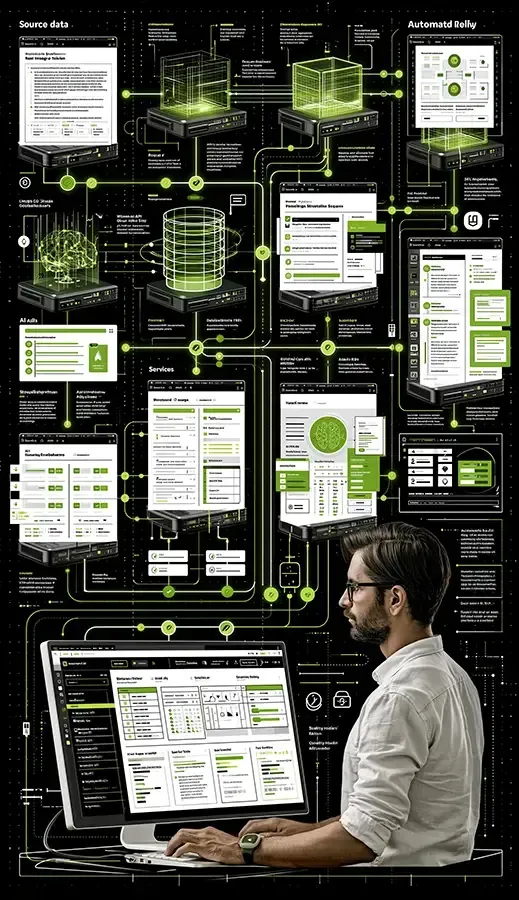
Once the product direction is clear, the challenge becomes coordinating all the systems, tools, and contributors required to make it function.
Modern digital products rarely operate in a silo, often depending, content-management systems, databases, payment services, external APIs, automated communications, structured data, and specialized human expertise.
digiM manages this complexity by translating approved requirements into focused development phases and assigning each platform or AI system a clearly defined role.
This orchestration includes:
- Structuring development into manageable phases — defining what should be addressed now, what depends on earlier work, and what should remain outside the current scope.
- Directing AI systems with precise context — providing business objectives, technical constraints, preserved architecture, prohibited changes, testing requirements, and clear acceptance criteria.
- Coordinating platforms and integrations — aligning databases, APIs, content systems, payment tools, automated workflows, and user-facing interfaces so information moves accurately between them.
- Reconciling AI recommendations and technical tradeoffs — comparing outputs from different tools, questioning uncertain guidance, and determining which solution best supports the product, user, and operating model.
- Connecting human and technical contributors — translating complex implementation issues into clear language for clients, subject-matter experts, and other stakeholders.
AI can accelerate coding, analysis, data preparation, and technical problem-solving, but it does not automatically understand how every decision affects the broader product.
digiM provides the HI needed to maintain that full-system view. Keping the work aligned across platforms, correcting incomplete or conflicting outputs, and ensuring technical execution continues to serve the product’s larger purpose.
Validating, Protecting, and Scaling for Production


A digital product is not production-ready simply because its features appear to work in a controlled test. It must also perform reliably with real data, preserve existing systems and user records, handle failures responsibly, and remain financially and operationally sustainable as usage grows.
digiM approaches this stage through structured validation rather than assumption. That means testing individual functions, complete user journeys, live integrations, database behavior, automated processes, and deployment conditions—not merely reviewing whether an AI-generated implementation looks correct on the surface.
Production readiness also requires rollout plans that avoid unnecessary changes to stable architecture, prevent data loss, duplication and reduce the risk of exposing unfinished features to users. Thus it is important to:
- Test against defined acceptance criteria — confirming that each requirement has been implemented and behaves correctly across realistic scenarios.
- Verify live systems and integrations — checking API responses, database writes, payment states, scheduled processes, search results, and automated communications in their actual operating environment.
- Protect users, data, and existing functionality — preserving historical records, preventing duplicate activity, maintaining backups, and avoiding broad changes that could disrupt stable features.
- Manage release risk — using controlled rollouts, feature flags, limited access, monitoring, and fallback options when a change could affect production users or public content.
- Plan for sustainable growth — evaluating API consumption, AI usage, platform limits, recurring vendor costs, maintenance needs, and the economics of serving more users or records.
Scaling is not only a technical question. A system can function correctly but it may grow, if not properly monitored, into something impractical or result in unexpected costs to mantain.
digiM therefore evaluates production decisions against both performance and business sustainability—seeking solutions that remain reliable, maintainable, and cost-effective as the product expands.
The Human-Led AI Development of Today
AI can accelerate processes, but developing a successful digital product still requires coordinating systems, a clear strategy, and:
Defining clear objectives, actionable requirements, and well-established guardrails to keep AI-assisted development focused.
Aligning all platforms by connecting AI tools, databases, APIs, content systems, and automated workflows into a unified product.
Transitioning to production with confidence by applying structured QA, controlled rollout, and cost planning to ensure the system is reliable, scalable, and sustainable.
Questions? Contact me via:


Transform Your Idea Into a Production-ready System.
Transform your idea into a production-ready system
We begin by assessing your product idea, target users, desired platforms, data requirements, and any technical constraints or integrations. Next, we create a clear plan that aligns your business goals with the development, testing, and launch process.
We do not use fixed contracts or a standard process. Instead, we tailor our approach to your product, resources, and growth objectives. Typical expectations include:
- Product requirements and phased development roadmap
- User experience, content, and data-structure planning
- AI workflow and platform coordinatio
- Integration and technical tradeoff evaluation
- Quality assurance and controlled rollout planning
- Cost, scalability, and long-term maintenance guidance
Questions? Email at contact@digim.consulting

We got it.
Thank you for contacting us.We’ll get back to you as soon as possible.

With AI radically changing the digital search landscape, tried-and-true SEO tactics are quickly becoming obsolete

AI answers are dramatically reducing organic search traffic, forcing websites to work harder to retain and convert new visitors.

Well-crafted video and graphics can slow audiences down just long enough for your message to land and be remembered.