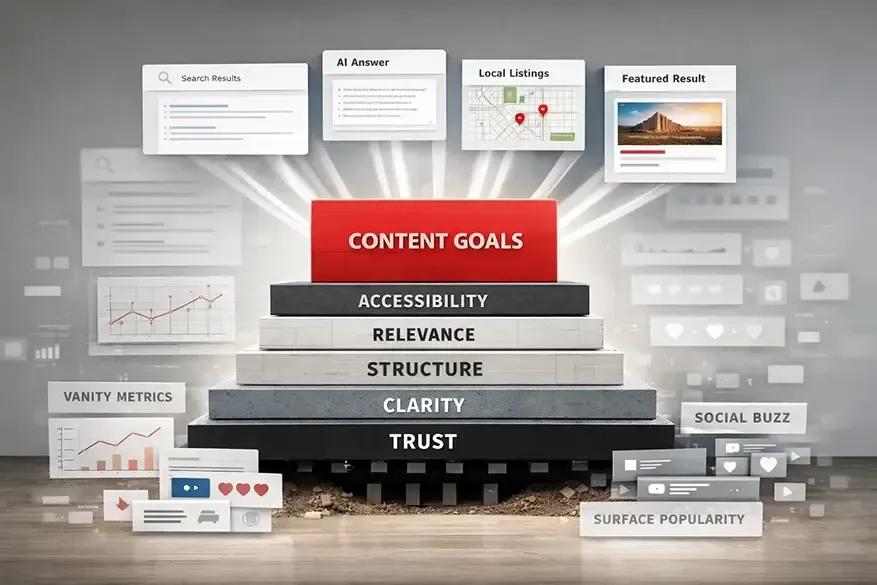
To keep this practical, I frame modern B2B digital marketing around four main pillars:
- Search Visibility in the AI + GEO Era
- Content as a Buying Journey (Not Just “More Blog Posts”)
- Account-Aware / ABM-Lite Strategy
- Analytics & Feedback Loops
Let’s walk through each pillar and build an integrated B2B strategy for today’s challenges.
1. Search Visibility in the AI + GEO Era
Traditional SEO focused on three big questions:
- Can search engines
crawl your site?
- Can they index your pages?
- Can you rank for the keywords that matter?
These factors remain important. However, AI-driven search and Generative Engine Optimization (GEO), which involves optimizing content for how AI systems summarize, recommend, and cite information, now add a new dimension:
- Do your brand, products, and ideas show up as trusted entities—not just URLs?
A few key shifts I prioritize with clients:
- From purely informational to commercial & transactional intent
- Informational queries (“what is X?”) are increasingly answered by AI directly in the interface.
- I now focus
my research on queries and assets that signal intent to evaluate, compare, or purchase, such as solution overviews, comparison pages, implementation guides, and downloadable resources.
- From random keywords to structured search intent
- Mapping keywords into clear intent buckets: informational, commercial, transactional, and navigational.
- Prioritize terms and topics that drive meaningful conversations, demos, and deals, rather than focusing solely on traffic
- From isolated pages to entity-level authority
- Ensure your brand, products, and key people are consistently described on your site and reputable third-party sites.
- Use structured data, comprehensive FAQs, and a focused thematic approach to help search engines and AI recognize your credibility
My digital marketing research includes SERP analysis, keyword and intent mapping, and competitive content gap analysis, all of which inform a clear, practical strategy.
2. Content as a Buying Journey, Not Just a Blog Calendar
Blog posts remain valuable, but they are just one component of a broader content ecosystem. In B2B, I focus on journey-supporting assets rather than simply increasing content volume:
- Decision guides & comparison pages
- Help prospects understand how you differ from alternatives.
- ROI and value one-pagers
- Give champions within the organization something they can forward.
- Downloadable PDFs and infographics
- Turn complex concepts into something skimmable and shareable.
- Explainer videos
and product walk-throughs
- Reduce confusion, demonstrate real workflows, and build confidence.
- FAQs and implementation guides
- Address practical concerns that often stall internal approvals.
Effective B2B content goes beyond attracting clicks. It:
- Answers real questions from multiple stakeholders
- Reduces friction at each step of the buying process
- Provides your sales team with assets they can use in outreach, demos, and follow-ups
When developing content plans with clients, I map content to key stages: early-stage education, mid-funnel evaluation, and late-stage decision support.
3. Account-Aware / ABM-Lite, Without Needing Enterprise Martech
Account-based marketing (ABM) is often presented as requiring a large tech stack and a dedicated team. For many organizations, that’s just not realistic.
Fortunately, you can still apply ABM principles in a streamlined, account-aware manner:
- Tiered account lists
- Identify a set of high-value accounts or segments (e.g., specific types of labs, hospitals, or enterprises).
- Tailored landing pages or content paths
- Create pages or content collections that speak directly to those segments’ use cases and language.
- Coordinated outreach and content
- Align email, webinars, LinkedIn outreach, and sales touchpoints around the same story.
An example might look like:
- Targeting 10–20 key prospects in a specific niche
- Create a focused landing page that addresses their specific workflow
- Support this with a short explainer video, a case study, and a downloadable PDF
- Coordinate sales outreach to ensure these assets are shared consistently
For example, a regional lab client targeted 30 key accounts with tailored landing pages and assets, resulting in a threefold increase in demo requests compared to untargeted outreach. This demonstrates that ABM-style relevance is achievable without a large marketing operations budget.
4. Analytics & Feedback Loops That Actually Matter
Measurement brings all efforts together, yet many B2B marketing programs fall short in this area. Rather than focusing on vanity metrics, I prioritize indicators that drive deals forward:
Pipeline & Revenue Indicators
- Demo requests and inquiry forms
- Sales-qualified leads and opportunities created
- Deals influenced or closed with marketing touchpoints
Behavioral Signals
- Time spent on key pages (not just the homepage)
- Return visits from the same organization or region
- Engagement with high-intent assets: pricing pages, comparison pages, technical documentation, explainer videos
Channel & Content Performance
- Which search queries bring in visitors who convert or start conversations
- Which pages assist conversions most frequently
- Which pieces of content does your sales team repeatedly use or request?
Tools such as GA4, Google Search Console, Bing Webmaster Tools, HubSpot, Clarity Analytics, and dashboards provide ample data. The true value comes from interpreting this information and translating it into actionable next steps, rather than simply generating monthly reports.
Account-Based Marketing in Practice
Let’s examine ABM more closely, as it remains important for many B2B organizations. Rather than casting a wide net, ABM begins by identifying key accounts and tailoring efforts accordingly:
- Define your ideal account profiles
- Industry, size, tech stack, region, regulatory environment, etc.
- Align content and offers to those profiles
- Industry-specific use cases
- Role-specific messaging (for scientists vs. executives, for example)
- Coordinate channels around that focus
- Email, LinkedIn, webinars, sales outreach, retargeting (if appropriate)
Most B2B marketers who implement ABM report stronger ROI compared to broad, untargeted campaigns. The key factor is intentionality, not software.
I assist smaller teams in implementing ABM-lite strategies, including targeted account lists, tailored content, and coordinated outreach that align with their available resources and budget.
Visual Storytelling for Complex B2B Offers
In complex B2B environments, especially technical, scientific, or regulated spaces visuals are not decoration. They are part of how you teach.
Well-designed visuals and video content:
- Make abstract ideas concrete
- Shorten the time it takes for someone to “get it”
- Support both marketing and sales, online and offline
This can include:
- Short explainer videos to walk through workflows or platforms
- Simple diagrams and infographics that clarify concepts or processes
- Custom blog visuals and thumbnails that reinforce key topics
- Screenshots and UI callouts that show software in context
Text-only pages are increasingly easy for AI to summarize, having potential site-visitors bypass your site completely. Visuals and video are more valuable since they increase your odds of still showing up on
top of a search result page.
Measuring Success: Beyond Traffic and Impressions
To summarize, here is how I define success in modern B2B marketing:
- Are we making it easier for the right people to find you?
- Are we giving internal champions the content they need to advocate for you?
- Are we seeing real signals—conversations, demos, deals—that align with your goals?
Measurement is not about perfection; it is about establishing an honest feedback loop between your efforts and outcomes. This enables ongoing refinement. the AI + GEO Era
B2B Marketing Trends in the AI + GEO Era
A few trends I pay close attention to as we move forward:
AI-Assisted, Human-Led Content
AI speeds up drafting, research, and ideation. Humans still provide judgment, nuance, and lived experience. The best content combines both.
GEO & AI Search Experiences
AI overviews, chatbots, and LLM-powered assistants are changing how people discover brands. Visibility now includes being recognized as a trusted entity—not just ranking in a list of links. (Quality Incentive Company)
First-Party Data & Owned Audiences
As organic reach becomes less predictable, email lists, webinars, and communities become more important. These are spaces where you own the relationship—not an algorithm.
Video, Webinars & On-Demand Education
B2B buyers increasingly prefer to self-educate. Clear, honest video and live/on-demand sessions bridge the gap between marketing and training.
Buyer Enablement Over Lead Gen
The objective is not simply to collect leads, but to help buying committees make confident decisions. This requires improved user experience, clearer content, and a streamlined process.
Bringing It All Together